Cooking up a jam enterprise: How student turned campus idea into commercial success
By Sammy Waweru
In 2020, while in his fourth year pursuing a degree in agribusiness management, Jimmy Aluvisia made a decision that has since redefined his career path.
What began as a small student project rooted in curiosity, opportunity, and a desire to solve agricultural challenges, has since grown into a thriving strawberry supply and jam-processing enterprise that today serves supermarkets, hotels, and bakeries across several counties.
The bulb moment
The youthful entrepreneur from Kakamega recalls that the idea first took shape during his attachment at the Kenya Plant Health Inspectorate Service (Kephis). He was tasked with activities related to plant propagation, exposure that opened his eyes to a gap in the strawberry value chain.
"While working at Kephis I realised that strawberries are high-value fruits, yet only a few farmers in the country grow them," he says. He says the demand is high, but access to quality seedlings is the biggest barrier.
Armed with this insight, he set up a small nursery shortly after resuming his studies at Great Lakes University, Kisumu. His goal was simple: produce clean, climate-resilient strawberry seedlings and supply them to farmers across Nyanza and Western Kenya.
According to Aluvisia, the nursery quickly gained traction. He supplied farmers with quality and reliable seedlings. Additionally, he supplied NGOs that support farmers.
The turning point
However, the business soon exposed its limitations. "Most farmers I worked with relied heavily on rain-fed agriculture. Seedling demand peaked only during the rainy season, leaving me with little income during the dry months," he recalls.
"I realised that I was making money only when the rains came. I needed something that could sustain me throughout the year," he adds. The challenge became the turning point that pushed him deeper into the strawberry value chain.
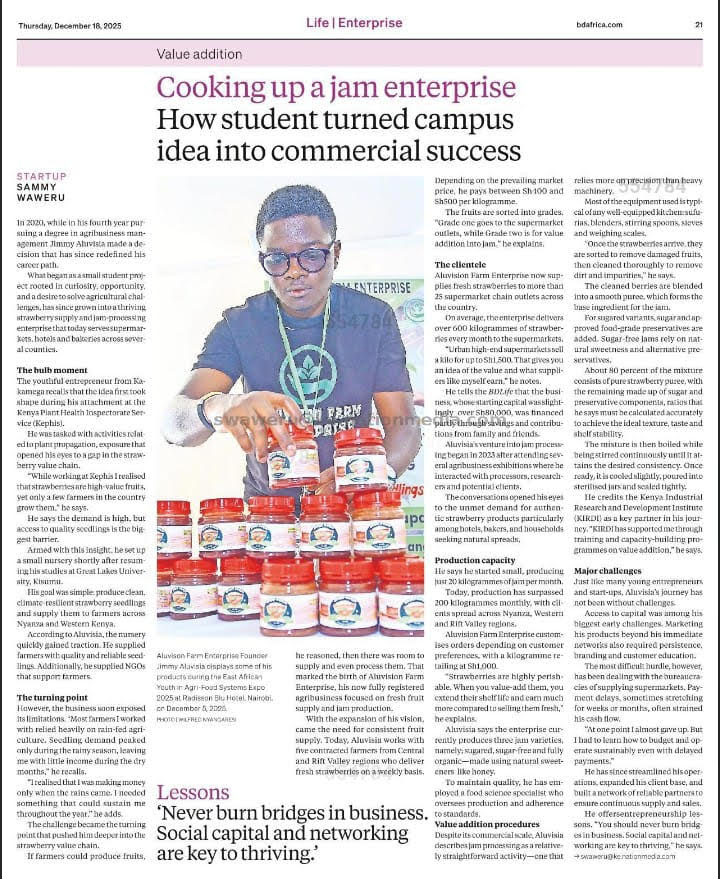
"If farmers could produce fruits," he reasoned, "then there was room to supply and even process them." That marked the birth of Aluvison Farm Enterprise, his now fully registered agribusiness focused on fresh fruit supply and jam production.
With the expansion of his vision, came the need for consistent fruit supply. Today, Aluvisia works with five contracted farmers from Central and Rift Valley regions who deliver fresh strawberries on a weekly basis.
Production capacity
He says he started small, producing just 20 kilogrammes of jam per month. Today, production has surpassed 200 kilogrammes monthly, with clients spread across Nyanza, Western and Rift Valley regions.
Aluvison Farm Enterprise customises orders depending on customer preferences, with a kilogramme retailing at Sh1,000.
"Strawberries are highly perishable. When you value-add them, you extend their shelf life and earn much more compared to selling them fresh," he explains.
Aluvisia says the enterprise currently produces three jam varieties, namely; sugared, sugar-free and fully organic—made using natural sweeteners like honey.
Value addition procedures
Despite its commercial scale, Aluvisia describes jam processing as a relatively straightforward activity—one that relies more on precision than heavy machinery. Most of the equipment used is typical of any well-equipped kitchen: sufurias, blenders, stirring spoons, sieves and weighing scales.
"Once the strawberries arrive, they are sorted to remove damaged fruits, then cleaned thoroughly to remove dirt and impurities," he says. The cleaned berries are blended into a smooth puree, which forms the base ingredient for the jam.
For sugared variants, sugar and approved food-grade preservatives are added. Sugar-free jams rely on natural sweetness and alternative preservatives.
About 80 percent of the mixture consists of pure strawberry puree, with the remaining made up of sugar and preservative components, ratios that he says must be calculated accurately to achieve the ideal texture, taste and shelf stability.
The mixture is then boiled while being stirred continuously until it attains the desired consistency. Once ready, it is cooled slightly, poured into sterilised jars and sealed tightly.
The clientele
Aluvison Farm Enterprise now supplies fresh strawberries to more than 25 supermarket chain outlets across the country. On average, the enterprise delivers over 600 kilogrammes of strawberries every month to the supermarkets.
"Urban high-end supermarkets sell a kilo for up to Sh1,500. That gives you an idea of the value and what suppliers like myself earn," he notes.
He tells the BDLife that the business, whose starting capital was slightly over Sh80,000, was financed partly through savings and contributions from family and friends.
Major challenges
Just like many young entrepreneurs and start-ups, Aluvisia's journey has not been without challenges. Access to capital was among his biggest early challenges. Marketing his products beyond his immediate networks also required persistence, branding and customer education.
The most difficult hurdle, however, has been dealing with the bureaucracies of supplying supermarkets. Payment delays, sometimes stretching for weeks or months, often strained his cash flow.
"At one point I almost gave up. But I had to learn how to budget and operate sustainably even with delayed payments." He has since streamlined his operations, expanded his client base, and built a network of reliable partners to ensure continuous supply and sales.